XRPL Blockchain Architecture: Why the XRP Ledger Powers Institutional Tokenization
A comprehensive technical exploration of the XRP Ledger's consensus protocol, ledger structure, and unique features that make it the optimal blockchain for institutional Real-World Asset tokenization—including performance benchmarks, security analysis, and developer integration guides.
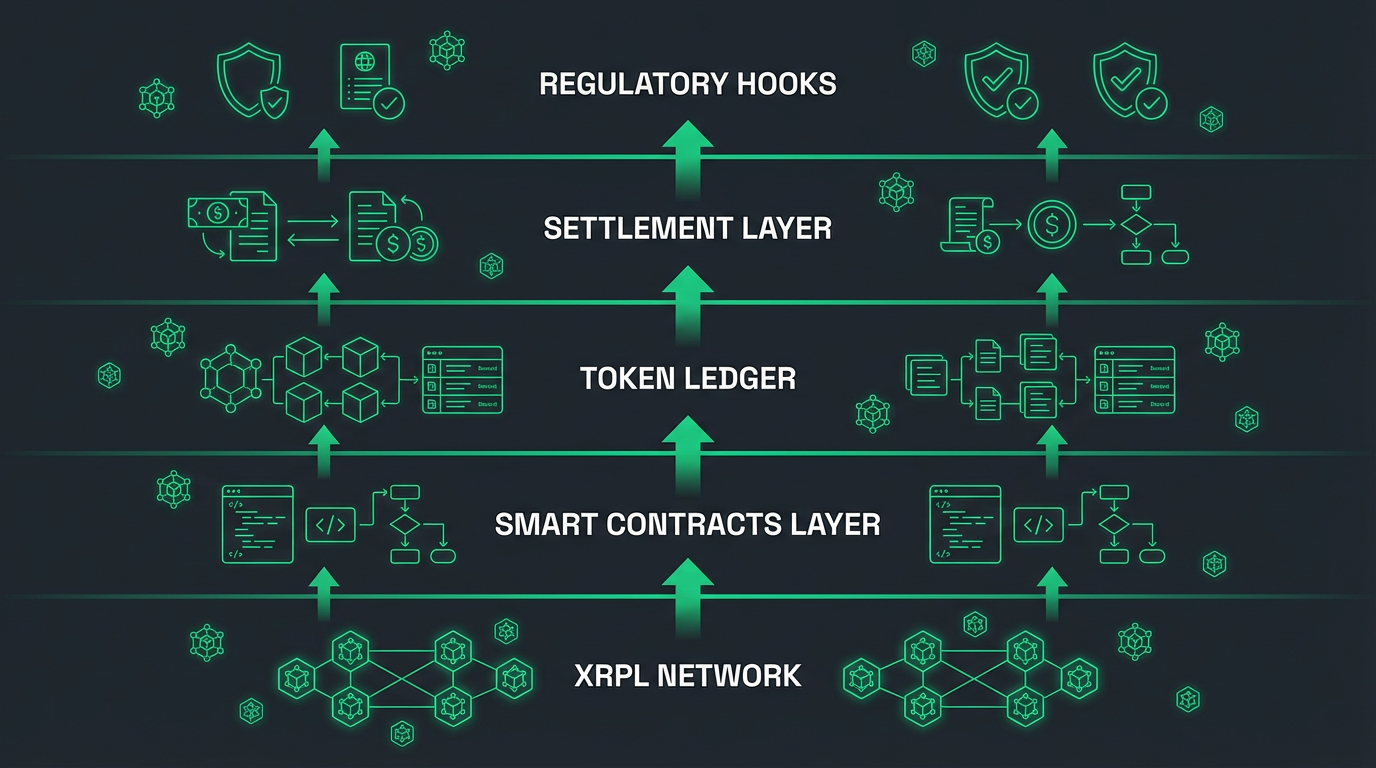
The XRP Ledger (XRPL) has emerged as a cornerstone technology for institutional digital asset infrastructure. This deep technical analysis explores XRPL's architecture, consensus mechanism, and unique features that make it ideally suited for Real-World Asset (RWA) tokenization.
XRPL Architecture Fundamentals
Understanding XRPL requires examining its core components and how they interact to create a secure, scalable blockchain capable of handling institutional transaction volumes.
Consensus Protocol: The XRP Ledger Consensus Algorithm
Unlike proof-of-work blockchains that require energy-intensive mining or proof-of-stake systems that concentrate power among large token holders, XRPL employs a unique federated Byzantine agreement (FBA) protocol.
How XRPL Consensus Works
The consensus process operates through a network of independent validators that propose and verify transactions:
- Transaction Submission: Users broadcast transactions to the network
- Candidate Set Formation: Validators collect pending transactions into candidate sets
- Proposal Round: Each validator proposes their candidate set to their unique node list (UNL)
- Validation Round: Validators exchange proposals and iteratively converge on a common set
- Ledger Close: When 80% of UNL agrees on a transaction set, the ledger closes
- Validation: Validators sign the new ledger and broadcast it to the network
This process completes in 3-5 seconds with mathematical finality—once a transaction is validated, it cannot be reversed. Compare this to Bitcoin's 10-minute block times or Ethereum's probabilistic finality, and XRPL's advantages become clear.
Byzantine Fault Tolerance
XRPL's consensus algorithm tolerates up to (n-1)/5 Byzantine failures, where n is the number of validators in a UNL. This means the network remains operational even when 20% of validators are malicious or offline.
For institutional applications requiring high availability, this resilience is non-negotiable. Even in worst-case scenarios with coordinated attacks, the network maintains integrity and continues processing transactions.
Ledger Structure & Data Organization
Each XRPL ledger represents a complete snapshot of account balances, settings, and data objects at a specific point in time.
Ledger Components
| Component | Purpose | Technical Details |
|---|---|---|
| Ledger Header | Metadata about the ledger | Sequence number, close time, hash references |
| Account State | Current balances and settings | XRP balances, trust lines, offers, escrows |
| Transaction Set | Executed transactions in this ledger | Ordered list with metadata and results |
| State Tree | Merkle tree of all account states | Enables efficient state verification |
The ledger's Merkle tree structure allows for efficient verification of account states without downloading the entire ledger history—critical for institutional applications requiring rapid state queries.
Transaction Processing Pipeline
XRPL processes transactions through a multi-stage pipeline designed for maximum throughput and reliability:
Stage 1: Transaction Construction & Signing
Transactions are constructed by specifying the transaction type, required fields, and appropriate flags. Transactions must be cryptographically signed using the sender's private key before submission.
XRPL supports multiple signature algorithms:
- secp256k1: The same elliptic curve used by Bitcoin
- ed25519: EdDSA signature scheme for quantum resistance
- Multi-Signatures: Transactions requiring approval from multiple signers
Stage 2: Transaction Validation
Before a transaction enters the consensus process, it undergoes local validation checks:
- Signature verification
- Sufficient account balance for transaction fee
- Account sequence number correctness
- Transaction format compliance
- All required fields present
Transactions failing these checks are rejected immediately, preventing network spam and conserving consensus resources.
Stage 3: Consensus & Execution
Valid transactions proceed through the consensus process described earlier. Once consensus is achieved, transactions execute in canonical order, producing deterministic results across all validators.
Stage 4: Result Recording
Transaction results are permanently recorded in the ledger, including success/failure status, fee consumed, and any metadata changes. This immutable record provides the audit trail required for institutional compliance.
XRPL Features for Institutional Use Cases
Issued Currencies & Trust Lines
XRPL's issued currency system provides the foundation for tokenized assets. Any account can issue currencies representing real-world assets, with trust lines controlling which assets users choose to hold.
Trust Line Mechanism
Trust lines create a bidirectional relationship between two accounts for a specific currency. Before receiving an issued currency, users must explicitly create a trust line, providing built-in protection against unsolicited asset transfers.
Key trust line parameters:
- Limit: Maximum balance of the currency the account will hold
- Quality In/Out: Exchange rate adjustments for incoming/outgoing balances
- Flags: Authorization requirements and freeze capabilities
This system naturally maps to investment accreditation requirements—issuers can implement authorization flags ensuring only approved investors can hold tokenized securities.
Freezing & Regulatory Compliance
XRPL includes freeze functionality enabling issuers to comply with legal requirements:
Individual Freeze: Temporarily prevent a specific trust line from transferring the issuer's currency
Global Freeze: Freeze all balances of the issuer's currency across all accounts
No Freeze Flag: Issuers can permanently revoke freeze ability, useful for utility tokens
These features address regulatory requirements for securities trading, enabling issuers to respond to court orders, comply with sanctions, or halt trading during corporate actions.
Decentralized Exchange (DEX)
XRPL's built-in DEX enables automated asset trading without centralized intermediaries.
Order Book Structure
The DEX maintains order books for every currency pair, storing bids and asks directly in the ledger. Orders execute automatically when prices match, with no intermediary required.
Advanced order types include:
- Limit Orders: Buy or sell at specific price or better
- Fill-or-Kill: Execute completely or cancel entirely
- Immediate-or-Cancel: Execute what's possible immediately, cancel remainder
- Passive Orders: Only execute as a maker, never as a taker
Auto-Bridging via XRP
One of XRPL's most powerful features is auto-bridging: automatically routing trades through XRP when it provides better pricing than direct currency pair order books.
For example, trading AUD-tokenized property for USD-tokenized bonds might route through AUD→XRP→USD if that provides superior execution. This creates automatic liquidity bridges between all asset pairs, dramatically improving market efficiency.
Payment Channels
For high-frequency, low-value transactions, XRPL offers payment channels that enable off-ledger transaction streaming with on-ledger settlement.
Payment channels work through a three-phase lifecycle:
- Channel Creation: Sender locks up XRP in a channel pointing to a recipient
- Off-Ledger Payments: Sender issues signed claims authorizing payments from the channel
- Channel Closure: Recipient submits highest claim to withdraw funds on-ledger
This architecture enables millions of micro-transactions per second between two parties while only recording two transactions on-chain: channel open and close.
For institutional applications, payment channels enable real-time streaming payments, subscription models, and pay-per-use services without overwhelming the blockchain with transactions.
Escrow & Conditional Payments
XRPL's built-in escrow functionality enables sophisticated conditional payment logic without custom smart contracts.
Time-Locked Escrows
Escrows can lock XRP until a specific time, with optional expiration dates:
- Finish After: Escrow cannot be released before this time
- Cancel After: Escrow can be canceled after this time
These features enable vesting schedules, lockup periods, and scheduled payments—all without requiring external systems or smart contract complexity.
Conditional Escrows (Crypto-Conditions)
More advanced escrows can be locked with cryptographic conditions:
- Preimage Conditions: Requires revealing a preimage of a hash
- Prefix Conditions: Requires a message with a specific prefix
- Threshold Conditions: Requires meeting a threshold of sub-conditions
These primitives enable atomic swaps, cross-chain transactions, and complex multi-party agreements—all executing automatically on-chain when conditions are met.
Performance & Scalability
Transaction Throughput
XRPL currently handles 1,500 transactions per second with sub-second latency. This throughput exceeds most payment networks and provides headroom for institutional adoption.
Performance characteristics:
| Metric | XRPL | Bitcoin | Ethereum |
|---|---|---|---|
| Transactions per Second | 1,500 TPS | 7 TPS | 15-30 TPS |
| Transaction Finality | 3-5 seconds (absolute) | 60+ minutes (probabilistic) | 6+ minutes (probabilistic) |
| Transaction Cost | $0.0002 average | $5-50 depending on congestion | $1-100 depending on gas price |
| Energy per Transaction | 0.0079 kWh | 1,173 kWh | 62 kWh (pre-merge) |
For institutions processing thousands of daily transactions, XRPL's combination of high throughput, low cost, and fast finality provides significant operational advantages.
Network Scalability Roadmap
XRPL development focuses on increasing throughput without sacrificing decentralization:
Short-Term Improvements (1-2 Years)
- Negative UNL: Improved handling of offline validators
- Flow Control: Better congestion management
- Hooks (Smart Contracts): Programmable transaction logic
Medium-Term Enhancements (2-5 Years)
- Federated Sidechains: Independent chains with XRPL settlement
- Privacy Features: Confidential transactions for sensitive data
- Cross-Chain Bridges: Interoperability with other blockchains
Long-Term Vision (5+ Years)
- Sharding: Parallel transaction processing across multiple shards
- Zero-Knowledge Proofs: Enhanced privacy without sacrificing auditability
- Quantum-Resistant Cryptography: Future-proofing against quantum computers
Security Model & Threat Analysis
Cryptographic Foundations
XRPL's security rests on well-studied cryptographic primitives:
- SHA-512Half: Hashing algorithm for transaction IDs and ledger hashes
- ECDSA/EdDSA: Digital signature algorithms for transaction authorization
- Merkle Trees: Efficient state verification and fraud proofs
Attack Vectors & Mitigations
51% Attack: XRPL's consensus algorithm makes 51% attacks infeasible. Even with majority validator control, attackers cannot steal funds—only potentially censor transactions or cause network halts.
Double-Spend Attack: Mathematically impossible after ledger validation. XRPL provides absolute finality, not probabilistic finality.
Eclipse Attack: Isolating nodes from the honest network is prevented by diverse UNL selection and network topology monitoring.
DDoS Attack: Transaction fees and rate limiting protect against spam attacks. Increased network load raises minimum fees, making attacks economically prohibitive.
Key Management Best Practices
Institutional XRPL deployments implement multi-layer key management:
Hot/Cold Wallet Architecture
- Hot Wallets: Online, operational wallets with limited balances for daily transactions
- Warm Wallets: Semi-online wallets requiring multiple approvals for medium-value transactions
- Cold Wallets: Offline, air-gapped storage for bulk asset holdings
Multi-Signature Configuration
XRPL's native multi-signature support enables sophisticated approval workflows:
Configuration example for institutional asset custody:
- Master Key: Offline, stored in bank vault
- Regular Key 1: Operations team member (weight: 1)
- Regular Key 2: Compliance officer (weight: 1)
- Regular Key 3: Executive approval (weight: 2)
- Quorum: 3 weight required
This configuration requires any two operations/compliance members plus executive approval, or all three operations/compliance members without executive involvement.
XRPL vs. Alternative Blockchain Platforms
Comparison with Ethereum
While Ethereum offers greater smart contract flexibility, XRPL provides significant advantages for financial applications:
- Predictable Costs: XRPL fees are stable; Ethereum gas prices can spike 100x during congestion
- Faster Finality: 3-5 seconds absolute vs. 6+ minutes probabilistic
- Built-in Financial Primitives: DEX, escrow, payment channels native vs. requiring smart contracts
- Lower Complexity: Reduced attack surface without Turing-complete contracts
Comparison with Private Blockchains
Some institutions consider private blockchains like Hyperledger or R3 Corda. XRPL offers public blockchain benefits while addressing private blockchain advantages:
- Public Auditability: Transparent ledger enables third-party verification
- Network Effect: Access to global liquidity pools and trading counterparties
- No Vendor Lock-In: Open-source protocol vs. proprietary systems
- Proven Security: 10+ years of continuous operation without major security incidents
For use cases requiring true privacy, federated sidechains enable private transaction networks while maintaining settlement on the public XRPL.
Developer Experience & Integration
Client Libraries & SDKs
XRPL provides comprehensive tooling across major programming languages:
- xrpl.js: JavaScript/TypeScript library for Node.js and browsers
- xrpl-py: Python library for backend applications
- xrpl4j: Java library for enterprise integrations
- XRPL-Swift: iOS/macOS native development
- XRPL-PHP: PHP library for web applications
All libraries provide consistent APIs for:
- Account creation and management
- Transaction construction and signing
- Ledger and account data queries
- WebSocket subscription to live updates
API Infrastructure
XRPL nodes expose RESTful HTTP APIs and WebSocket connections for real-time data:
HTTP API
Request/response interface for queries and transaction submission:
- Account information queries
- Transaction history retrieval
- Order book snapshots
- Fee estimation
WebSocket API
Streaming interface for real-time updates:
- Transaction validation notifications
- Ledger close events
- Order book updates
- Account balance changes
Institutional platforms maintain persistent WebSocket connections for instant transaction confirmations and market data updates.
Testing & Development Networks
XRPL provides multiple networks for different stages of development:
- Mainnet: Production network with real value
- Testnet: Public test network with free test XRP
- Devnet: Development network with experimental features
- Private Networks: Custom networks for isolated testing
Developers can test integrations thoroughly on Testnet before deploying to Mainnet, reducing production risks and enabling comprehensive QA processes.
The Future of XRPL in Institutional Finance
Central Bank Digital Currencies (CBDCs)
Multiple central banks are exploring XRPL for CBDC implementation. The ledger's compliance features, performance characteristics, and mature infrastructure make it an attractive foundation for national digital currencies.
Cross-Border Payments
Ripple's ODL (On-Demand Liquidity) service leverages XRPL for instant, low-cost cross-border payments. As adoption grows, XRPL becomes the settlement layer for global payment flows.
Tokenized Securities
The combination of issued currencies, DEX functionality, and compliance features positions XRPL as ideal infrastructure for tokenized securities trading—exactly the use case Qoney addresses.
Conclusion: Why XRPL for RWA Tokenization
XRPL's unique combination of features makes it the optimal blockchain for institutional RWA tokenization:
- Performance: 1,500 TPS with 3-5 second finality
- Cost: Fractions of a cent per transaction
- Compliance: Built-in freeze, authorization, and access control
- Maturity: 10+ years of continuous operation
- Liquidity: Native DEX with auto-bridging
As institutional adoption of blockchain technology accelerates, XRPL's proven track record and purpose-built financial features position it as the backbone of tokenized asset markets.
For developers building on XRPL, comprehensive documentation, mature tooling, and active community support lower integration barriers and accelerate time-to-market.
The future of finance is tokenized, and XRPL provides the rails on which that future will be built.
Graham Chee
FCPA, GRCP, GRCA, IAIP, IRMP, ICEP, IAAP - Principal Advisor & Founder
Graham Chee is a highly qualified business advisor with over 25 years of professional experience spanning accounting, taxation, investment management, governance, risk, and compliance. As a Fellow of CPA Australia (FCPA), Graham brings deep technical expertise combined with practical business acumen. His qualifications include Governance Risk and Compliance Professional (GRCP), Governance Risk and Compliance Auditor (GRCA), Integrated Artificial Intelligence Professional (IAIP), Integrated Risk Management Professional (IRMP), Integrated Compliance and Ethics Professional (ICEP), and Integrated Audit and Assurance Professional (IAAP). Graham has advised hundreds of Australian SMEs on strategic planning, succession, business valuation, and compliance matters, helping business owners build sustainable, valuable enterprises.