Understanding Real-World Asset Tokenization in Australia: A Comprehensive Guide
Explore how blockchain technology is revolutionizing traditional asset ownership through tokenization, with a focus on the Australian regulatory landscape and institutional adoption.
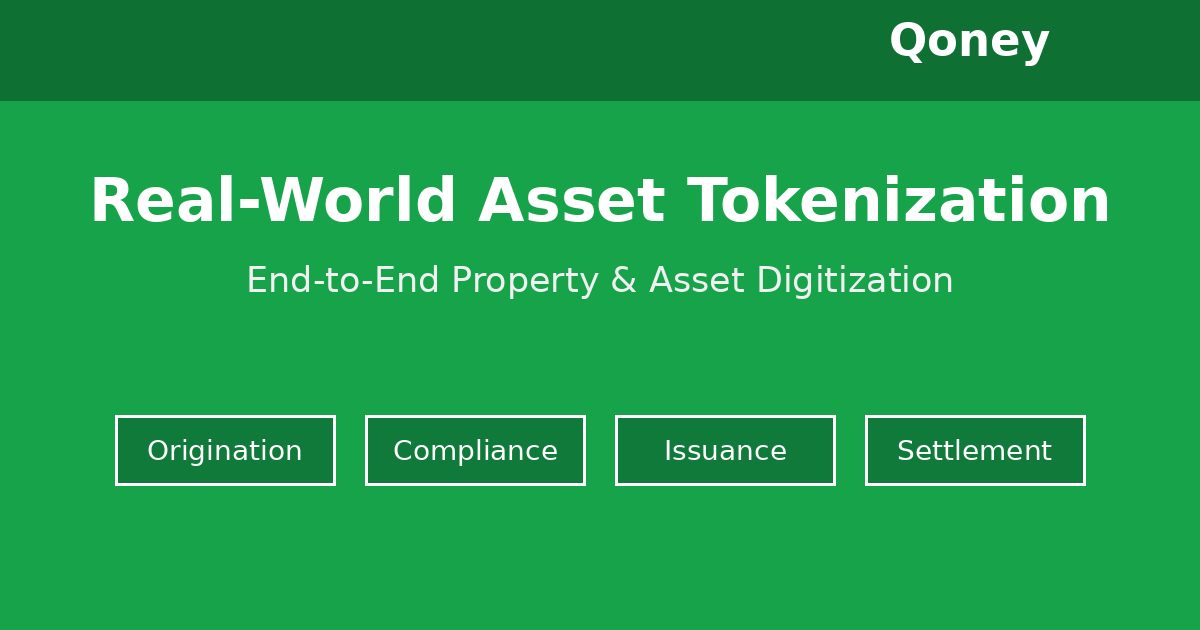
Real-world asset (RWA) tokenization represents a fundamental shift in how we conceptualize and manage ownership of physical and financial assets. By leveraging blockchain technology, particularly the XRP Ledger (XRPL), Australia is positioning itself at the forefront of this digital transformation.
The Foundation of Asset Tokenization
At its core, tokenization is the process of converting rights to an asset into a digital token on a blockchain. This transformation offers unprecedented opportunities for liquidity, fractional ownership, and automated compliance—all while maintaining regulatory oversight and investor protection.
Key Components of the Tokenization Process
The tokenization workflow consists of four critical stages that work in concert to ensure both technical integrity and regulatory compliance:
1. Asset Origination & Due Diligence
The process begins with comprehensive asset evaluation. Our front-office team conducts extensive due diligence, including title verification, valuation analysis, and legal structure assessment. This phase establishes the foundation for compliant tokenization by ensuring all asset details meet ASIC requirements.
Key activities include property inspections, financial statement analysis, and stakeholder interviews. We employ AI-powered risk assessment tools to identify potential issues early in the process, significantly reducing downstream complications.
2. Compliance & Legal Structuring
Middle-office operations focus on navigating the complex Australian regulatory landscape. Our compliance engine automatically checks against ASIC's managed investment scheme requirements, AUSTRAC's AML/CTF obligations, and Privacy Act considerations.
This stage involves structuring the offering document, establishing trustee relationships, and implementing investor suitability assessments. We leverage automated policy engines that ensure every step adheres to both federal and state-specific regulations.
3. Token Issuance & Smart Contract Deployment
The technical implementation phase brings tokens to life on the XRP Ledger. Smart contracts encode ownership rights, distribution rules, and transfer restrictions directly into immutable blockchain logic.
Our platform generates tokens with embedded compliance features including transfer restrictions, accredited investor verification, and automated reporting capabilities. Each token represents a specific ownership percentage, with precision calculations ensuring mathematical accuracy to 15 decimal places.
4. Settlement & Ongoing Administration
Back-office operations manage the lifecycle of tokenized assets. This includes automated distribution payments, NAV calculations, cap table reconciliation, and investor reporting. Our settlement engine integrates directly with XRPL's consensus mechanism, enabling near-instantaneous finality and reduced counterparty risk.
Australian Regulatory Landscape
Understanding the regulatory framework is paramount for successful tokenization in Australia. ASIC has provided increasingly clear guidance on digital asset offerings, treating most tokenized assets as managed investment schemes under the Corporations Act 2001.
ASIC's Digital Asset Guidance
ASIC's regulatory approach focuses on substance over form. Regardless of whether an asset is tokenized, if it meets the definition of a financial product—particularly a managed investment scheme—it falls under existing securities regulations.
Key requirements include:
- AFSL Licensing: Operators must hold an appropriate Australian Financial Services License
- Product Disclosure: Comprehensive PDS documentation outlining risks, fees, and investment strategy
- Responsible Entity: Appointment of a licensed trustee to oversee investor interests
- Custody Arrangements: Secure storage of both tokens and underlying assets
- Valuation Requirements: Independent asset valuations at regular intervals
AUSTRAC Compliance Obligations
Anti-money laundering and counter-terrorism financing requirements apply to all token offerings. Platforms must implement robust KYC procedures, transaction monitoring, and suspicious activity reporting.
Our platform automates AUSTRAC compliance through:
- AI-powered identity verification
- Real-time transaction monitoring with machine learning algorithms
- Automated SAR filing when thresholds are triggered
- Comprehensive audit trails for regulatory inspection
Benefits of Asset Tokenization
Enhanced Liquidity
Traditional assets like commercial real estate often suffer from illiquidity—buyers and sellers face high transaction costs and lengthy settlement periods. Tokenization creates fractional ownership opportunities, dramatically expanding the potential investor base and enabling secondary market trading.
By enabling 24/7 trading on digital exchanges, tokenized assets can achieve liquidity profiles closer to publicly traded securities while maintaining the fundamental characteristics of the underlying asset.
Democratized Access
Fractional ownership lowers the barrier to entry for institutional-grade assets. Instead of requiring millions of dollars to access premium commercial property, investors can participate with substantially smaller amounts while maintaining exposure to the same underlying economics.
This democratization extends beyond retail investors—it enables sophisticated portfolio managers to fine-tune asset allocation with precision previously impossible in traditional markets.
Automated Compliance
Smart contracts embed regulatory requirements directly into token logic. Transfer restrictions, distribution calculations, and reporting obligations execute automatically, reducing operational overhead and minimizing compliance errors.
Our compliance engine monitors every transaction in real-time, flagging potential issues before they escalate into regulatory breaches. This proactive approach protects both issuers and investors.
Operational Efficiency
Blockchain-based settlement eliminates intermediaries and reduces settlement timeframes from days to seconds. Our platform handles cap table management, distribution processing, and investor communications automatically, freeing teams to focus on strategic initiatives.
Cost reductions of 40-60% are common when compared to traditional fund administration, with error rates declining by similar magnitudes.
Case Study: Commercial Real Estate Tokenization
Consider a $50 million commercial property in Sydney's CBD. Traditional ownership structures require substantial capital commitments and sophisticated investor networks. Through tokenization:
- The asset is divided into 50 million tokens (each representing $1 of ownership)
- Minimum investment drops from $5 million to $10,000
- Rental income distributes quarterly via smart contract
- Investors can exit via secondary market trading
- Cap table updates automatically with each transaction
This structure maintains all regulatory protections while dramatically expanding accessibility and liquidity.
Technical Infrastructure
Why XRPL?
The XRP Ledger offers distinct advantages for institutional tokenization:
Speed & Finality
Transactions settle in 3-5 seconds with deterministic finality. Unlike proof-of-work chains requiring multiple confirmations, XRPL's consensus mechanism provides immediate certainty.
Cost Efficiency
Transaction fees average $0.0002—several orders of magnitude cheaper than Ethereum. This makes frequent distributions and trading economically viable.
Built-in DEX
XRPL includes a native decentralized exchange, enabling secondary market liquidity without relying on third-party infrastructure.
Institutional-Grade Performance
The ledger processes 1,500 transactions per second with proven uptime exceeding 99.99% since 2012.
Implementation Best Practices
Start with Clear Objectives
Define specific goals before beginning tokenization. Are you optimizing for liquidity, reducing costs, expanding the investor base, or achieving regulatory efficiency? Clear objectives guide structural decisions and technology choices.
Engage Legal and Compliance Early
Regulatory complexity demands expert guidance from day one. Work with advisors who understand both traditional securities law and blockchain technology to navigate the intersection effectively.
Prioritize Investor Experience
Technology should enhance—not complicate—the investor journey. Ensure intuitive interfaces, clear documentation, and responsive support systems.
Build for Scale
Even if starting with a single asset, design systems to handle multiple offerings. This includes unified investor onboarding, consolidated reporting, and integrated treasury management.
Looking Forward: The Future of Tokenization
Australia is emerging as a global leader in regulated tokenization. With clear regulatory frameworks, robust financial infrastructure, and increasing institutional adoption, the market is positioned for significant growth.
Key trends to watch include:
- Cross-border tokenization: International assets accessing Australian capital markets
- DeFi integration: Tokenized assets serving as collateral in decentralized finance protocols
- Institutional custody: Major banks and custodians supporting digital asset holdings
- Regulatory evolution: ASIC's ongoing refinement of digital asset guidance
Conclusion
Real-world asset tokenization represents a paradigm shift in capital markets. By combining blockchain technology with robust regulatory compliance, platforms like Qoney are making institutional-grade assets accessible to a broader investor base while maintaining the protections and standards that underpin trust in financial markets.
Success in this emerging sector requires equal parts technical sophistication, regulatory expertise, and operational excellence. As the Australian market continues to mature, early movers who prioritize compliance and investor protection will establish lasting competitive advantages.
For institutions and investors ready to explore tokenization opportunities, the time to engage is now. The infrastructure exists, the regulations are clear, and the market momentum is building.
Graham Chee
FCPA, GRCP, GRCA, IAIP, IRMP, ICEP, IAAP - Principal Advisor & Founder
Graham Chee is a highly qualified business advisor with over 25 years of professional experience spanning accounting, taxation, investment management, governance, risk, and compliance. As a Fellow of CPA Australia (FCPA), Graham brings deep technical expertise combined with practical business acumen. His qualifications include Governance Risk and Compliance Professional (GRCP), Governance Risk and Compliance Auditor (GRCA), Integrated Artificial Intelligence Professional (IAIP), Integrated Risk Management Professional (IRMP), Integrated Compliance and Ethics Professional (ICEP), and Integrated Audit and Assurance Professional (IAAP). Graham has advised hundreds of Australian SMEs on strategic planning, succession, business valuation, and compliance matters, helping business owners build sustainable, valuable enterprises.