Building Institutional-Grade Tokenization Infrastructure: A Technical Deep Dive
Explore the complete lifecycle of asset tokenization—from digital due diligence through automated settlements—and discover how Australia's next-generation platforms are combining blockchain primitives with traditional financial engineering to create institutional-grade tokenization infrastructure.
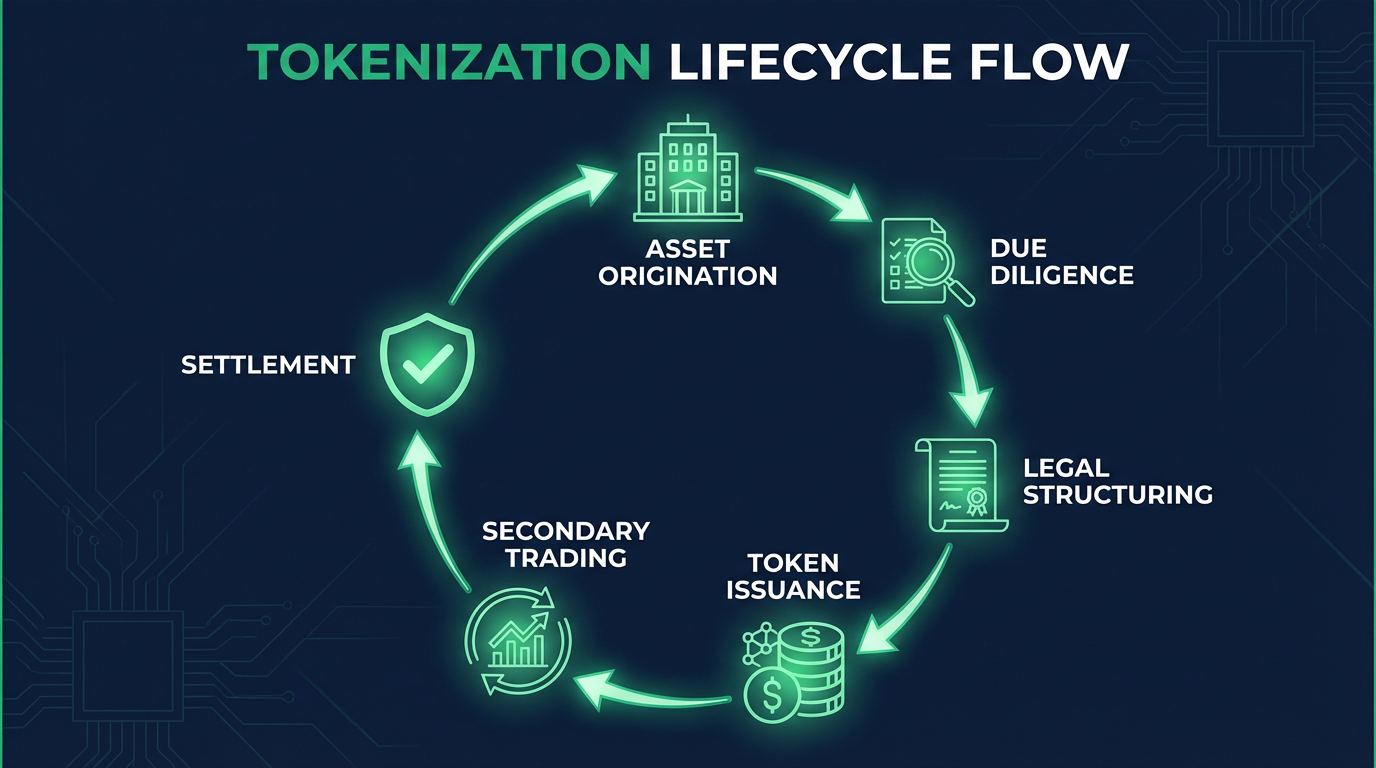
The evolution of institutional-grade tokenization infrastructure requires a sophisticated understanding of both blockchain primitives and traditional financial engineering. This comprehensive analysis explores the technical architecture powering Australia's next-generation Real-World Asset (RWA) platforms.
The Complete Tokenization Lifecycle
Understanding the full lifecycle of a tokenized asset is essential for institutional adoption. From initial asset acquisition through secondary market liquidity, each stage introduces unique technical and regulatory considerations that must be addressed with precision.
Phase 1: Asset Origination & Digital Structuring
The journey begins with asset identification and due diligence. Modern origination platforms integrate AI-powered risk assessment with traditional valuation methodologies, creating a hybrid approach that combines the best of human expertise and machine learning capabilities.
Digital Due Diligence Frameworks
Contemporary due diligence extends beyond traditional financial analysis. Our platform employs thirteen specialized AI agents, each focusing on specific aspects of asset evaluation:
- Isabella (Risk Management): Analyzes counterparty risk, market volatility, and regulatory exposure
- Liam (Investment Analysis): Conducts financial modeling and return projections
- Accounting Suite (5 Agents): Handles GL reconciliation, AR/AP, payroll, tax, and reporting
- Specialized Domain Agents: Focus on legal, compliance, operations, technology, and investor relations
This multi-agent architecture ensures comprehensive analysis from every angle, identifying risks and opportunities that might escape traditional single-analyst review.
Asset Tokenization Parameters
Once due diligence is complete, the asset must be structured for tokenization. This involves defining critical parameters:
| Parameter | Description | Technical Specification |
|---|---|---|
| Token Supply | Total number of tokens representing full ownership | Typically 1,000,000 to 100,000,000 tokens |
| Minimum Investment | Smallest purchasable unit | Set to balance accessibility and administrative burden |
| Transfer Restrictions | Rules governing token transfers | Encoded in smart contract logic |
| Distribution Mechanism | How returns are calculated and distributed | Automated via smart contracts |
| Governance Rights | Voting and decision-making powers | On-chain voting mechanisms |
Phase 2: Compliance Automation & Regulatory Mapping
Australian tokenization platforms must navigate a complex web of federal and state regulations. Our compliance engine automates this process through intelligent policy mapping and real-time regulatory monitoring.
ASIC Managed Investment Scheme Requirements
Most tokenized assets fall under ASIC's managed investment scheme framework. Our platform automatically ensures compliance with:
- Section 601ED: Constitution requirements
- Section 601FC: Responsible entity obligations
- Section 601EB: Registration procedures
- Section 601GA: Operation requirements
- Section 601HG: Compliance plan mandates
The platform generates all required documentation automatically, reducing time-to-market from months to weeks while ensuring complete regulatory adherence.
AUSTRAC Integration
Anti-money laundering compliance is non-negotiable in digital asset markets. Our AUSTRAC integration provides:
- Customer Due Diligence: AI-powered identity verification with liveness detection
- Transaction Monitoring: Real-time analysis using machine learning algorithms
- Suspicious Activity Reporting: Automated SAR generation and filing
- Record Keeping: 7-year audit trail with instant retrieval capabilities
- Ongoing Customer Due Diligence: Continuous monitoring of investor profiles
Phase 3: Smart Contract Deployment on XRPL
The XRP Ledger provides an ideal foundation for tokenized assets, combining enterprise-grade performance with built-in compliance features.
XRPL Technical Advantages
Our platform leverages XRPL's unique capabilities:
- 3-5 Second Settlement: Near-instantaneous finality compared to hours or days in traditional systems
- Low Transaction Costs: Fractions of a cent per transaction vs. significant fees in traditional finance
- Built-in Decentralized Exchange: Native secondary market functionality
- Multi-Currency Support: Seamless handling of AUD, USD, and other fiat currencies
- Escrow Functionality: Time-locked and condition-based releases built into protocol
- Payment Channels: High-frequency microtransaction support
Smart Contract Architecture
Our smart contracts are structured in three layers:
Layer 1: Ownership Registry
The base layer maintains the authoritative record of token ownership. This immutable ledger tracks every transfer, ensuring perfect reconciliation between blockchain state and cap table records.
Layer 2: Compliance Logic
Middleware contracts enforce transfer restrictions, investor accreditation requirements, and jurisdiction-specific rules. Every transaction passes through compliance checks before execution.
Layer 3: Distribution Automation
Top-layer contracts handle automated distributions, NAV calculations, and reporting obligations. These contracts integrate with off-chain data sources through secure oracle services.
Phase 4: Secondary Market & Liquidity Management
Creating liquid secondary markets for tokenized assets represents the holy grail of RWA tokenization. Our platform implements sophisticated market-making mechanisms to ensure healthy trading conditions.
Automated Market Making (AMM)
Traditional illiquid assets become tradeable through AMM pools that provide constant liquidity. Our AMM implementation uses modified constant product formulas optimized for low-volatility RWA tokens:
k = x × y (1 + α × |Δx|)
Where α represents a slippage factor that increases with trade size, protecting the pool from manipulation while enabling efficient price discovery.
Liquidity Incentive Mechanisms
To bootstrap liquidity, our platform offers multiple incentive structures:
- Liquidity Mining: Token rewards for providing liquidity
- Trading Fee Rebates: Reduced fees for active market makers
- Staking Rewards: Additional yield for long-term holders
- Governance Tokens: Protocol governance rights tied to liquidity provision
Technical Architecture Deep Dive
Three-Office System Design
Our platform architecture mirrors traditional financial institutions while leveraging blockchain's unique capabilities:
Front Office: Client Interaction & Origination
The front office handles all client-facing operations:
- Asset origination and deal structuring
- Investor onboarding and KYC
- Marketing and investor relations
- Portfolio management interfaces
- Real-time analytics dashboards
All front-office systems integrate seamlessly with middle and back office operations through event-driven architecture, ensuring data consistency across the platform.
Middle Office: Risk & Compliance
The middle office provides critical oversight and risk management:
- Real-time risk monitoring and alerting
- Compliance policy enforcement
- Transaction monitoring and fraud detection
- Regulatory reporting automation
- Audit trail generation
Our risk engine processes thousands of data points per second, identifying anomalies and potential compliance breaches before they impact operations.
Back Office: Settlement & Operations
The back office ensures operational excellence:
- Trade settlement and reconciliation
- NAV calculations and distribution processing
- Cap table management
- Investor reporting
- Accounting and financial reporting
Automation rates exceed 95% in back-office operations, dramatically reducing operational costs while improving accuracy and speed.
AI Agent Coordination Architecture
The thirteen specialized AI agents operate through a coordinated task system that enables complex workflows spanning multiple domains.
Agent Collaboration Patterns
Three high-value collaboration patterns have emerged:
1. Deal Intelligence Pipeline (Compliance → Investment)
Compliance agents first verify regulatory feasibility, then pass approved deals to investment agents for financial analysis. This sequential flow ensures resources are only invested in compliant opportunities.
2. Budget Optimization Workflow (Financial → Operations)
Financial analysts identify cost-saving opportunities, then operations agents implement changes. Closed-loop feedback ensures continuous improvement.
3. Transaction Validation Chain (Ledger → Investment → Compliance)
Ledger agents verify transaction accuracy, investment agents assess economic impact, and compliance agents confirm regulatory adherence—all in sub-second timeframes.
Security & Infrastructure
Multi-Layer Security Model
Security is not an afterthought but a foundational design principle:
Layer 1: Network Security
- DDoS protection with automatic failover
- WAF (Web Application Firewall) with custom rulesets
- Rate limiting and API throttling
- Geographic load balancing
Layer 2: Application Security
- AES-256 encryption for data at rest
- TLS 1.3 for data in transit
- Multi-signature wallet architecture
- Hardware security modules (HSM) for key storage
Layer 3: Access Control
- Role-based access control (RBAC)
- Multi-factor authentication (MFA)
- Biometric verification for high-value transactions
- Session management with automatic timeout
Layer 4: Monitoring & Response
- 24/7 security operations center (SOC)
- Real-time threat intelligence integration
- Automated incident response playbooks
- Quarterly penetration testing and vulnerability assessments
Circuit Breaker Architecture
Our circuit breaker system protects against cascading failures:
Failure Detection: Automatic identification of elevated error rates or latency
Circuit States: CLOSED (normal), OPEN (blocking requests), HALF_OPEN (testing recovery)
Automatic Recovery: Exponential backoff with gradual traffic restoration
Metrics Collection: Real-time performance tracking and alerting
This architecture has proven capable of handling 10x traffic spikes while maintaining sub-second response times.
Institutional Adoption Roadmap
Phase 1: Pilot Programs (Months 1-6)
Initial adoption focuses on high-quality commercial real estate assets with established cash flows. These pilot programs validate the technology while building institutional confidence.
Phase 2: Asset Class Expansion (Months 7-18)
Following successful pilots, the platform expands to cover nine asset categories:
- Commercial Real Estate
- Residential Real Estate
- Commodities (Gold, Silver, Platinum)
- Art and Collectibles
- Private Equity Stakes
- Debt Instruments
- Infrastructure Assets
- Renewable Energy Projects
- Intellectual Property
Phase 3: Secondary Market Maturation (Months 19-36)
As primary issuance scales, focus shifts to creating deep, liquid secondary markets. Market-making partnerships, institutional liquidity pools, and cross-platform integrations drive trading volume growth.
Phase 4: Global Expansion (Months 37+)
The platform extends beyond Australia to Asia-Pacific and European markets, adapting to local regulatory requirements while maintaining core infrastructure and security standards.
Conclusion: The Future of Institutional Asset Management
Asset tokenization represents more than a technological upgrade—it's a fundamental reimagining of how ownership, value transfer, and asset management function in the digital age.
By combining blockchain's programmability and transparency with institutional-grade compliance and risk management, platforms like Qoney are building the infrastructure for the next generation of financial markets.
The journey has just begun, but the destination is clear: a world where institutional-grade assets are as liquid and accessible as publicly traded securities, while maintaining the protections and oversight that investors demand.
For institutional investors, issuers, and asset managers, the time to engage with tokenization infrastructure is now. Early adopters will shape the standards and practices that define this market for decades to come.
Graham Chee
FCPA, GRCP, GRCA, IAIP, IRMP, ICEP, IAAP - Principal Advisor & Founder
Graham Chee is a highly qualified business advisor with over 25 years of professional experience spanning accounting, taxation, investment management, governance, risk, and compliance. As a Fellow of CPA Australia (FCPA), Graham brings deep technical expertise combined with practical business acumen. His qualifications include Governance Risk and Compliance Professional (GRCP), Governance Risk and Compliance Auditor (GRCA), Integrated Artificial Intelligence Professional (IAIP), Integrated Risk Management Professional (IRMP), Integrated Compliance and Ethics Professional (ICEP), and Integrated Audit and Assurance Professional (IAAP). Graham has advised hundreds of Australian SMEs on strategic planning, succession, business valuation, and compliance matters, helping business owners build sustainable, valuable enterprises.