Fractional Ownership Revolution: How Tokenization Democratizes Institutional Investing
Learn how fractional ownership through tokenization is transforming wealth creation by making institutional-grade assets accessible to everyday investors—comprehensive guide covering nine asset categories, investment strategies, risk management, and tax considerations.
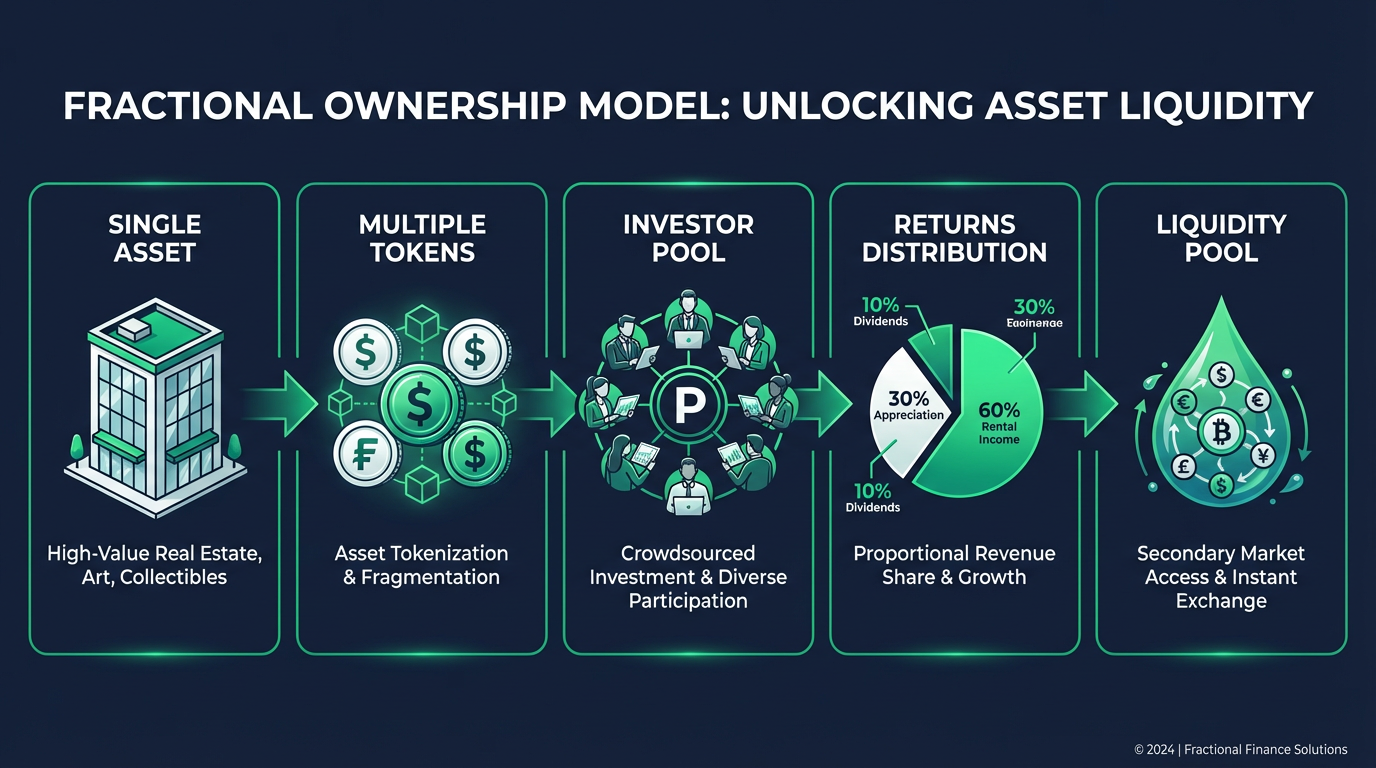
Fractional ownership through tokenization represents one of the most significant innovations in wealth creation since the invention of public stock markets. This comprehensive guide demystifies tokenized assets, explaining how everyday investors can access institutional-grade opportunities previously reserved for the ultra-wealthy.
Understanding Fractional Ownership
Traditionally, investing in premium assets like commercial real estate, fine art, or private equity required substantial capital—often millions of dollars. Fractional ownership changes this equation by dividing assets into smaller, tradeable units.
The Mathematics of Fractionalization
Consider a $10 million commercial property generating $600,000 annual net income:
Traditional Model:
- Minimum Investment: $10,000,000 (100% ownership)
- Annual Return: $600,000
- Investor Count: 1
- Liquidity: Extremely low (months to sell)
Tokenized Model:
- Total Tokens: 10,000,000
- Token Price: $1 each
- Minimum Investment: $1,000 (1,000 tokens = 0.01% ownership)
- Your Share of Annual Income: $60 per $1,000 invested (6% yield)
- Investor Count: Potentially thousands
- Liquidity: High (trade on secondary markets)
This fractionalization democratizes access while maintaining the economic characteristics of the underlying asset. Every token holder enjoys the same proportional returns as if they owned the entire property.
Economic Benefits of Fractionalization
1. Portfolio Diversification
Instead of concentrating $10M in a single property, investors can diversify across multiple assets:
| Asset Type | Allocation | Expected Return |
|---|---|---|
| Sydney CBD Office | $2,000 (20%) | 6.5% yield |
| Melbourne Retail | $2,500 (25%) | 5.8% yield |
| Gold Commodity | $1,500 (15%) | 3% appreciation |
| Private Equity Fund | $2,000 (20%) | 12% target IRR |
| Renewable Energy Project | $2,000 (20%) | 7.2% yield |
Portfolio Characteristics:
- Total Investment: $10,000
- Asset Classes: 5
- Geographic Diversification: Multiple states
- Risk Profile: Balanced
- Blended Expected Return: ~7-8%
This level of diversification was previously impossible for retail investors without mutual funds or REITs—but those vehicles charge management fees and lack transparency. Tokenization provides diversification with full asset visibility and lower costs.
2. Liquidity Transformation
Traditional real estate investments lock up capital for years. Token markets change this:
- Traditional Real Estate: 3-12 months to find buyer, complete due diligence, and settle
- Tokenized Real Estate: Seconds to minutes on secondary markets
This liquidity comes with caveats—market depth matters. Newly tokenized assets may have thin order books initially. However, as adoption grows, liquidity improves dramatically.
3. Lower Transaction Costs
Traditional property transactions involve substantial costs:
- Legal Fees: 0.5-1%
- Transfer Duty: 4-5.5% in most Australian states
- Agent Commissions: 2-3%
- Due Diligence: $10,000-$50,000
Total: 7-10% of transaction value
Tokenized asset transfers incur dramatically lower costs:
- Blockchain Transaction Fee: ~$0.0002 (negligible)
- Platform Trading Fee: 0.1-0.5%
- No stamp duty on secondary market trades (in most jurisdictions)
Total: <1% of transaction value
This cost differential enables strategies impossible in traditional markets—like rebalancing portfolios monthly instead of holding for years.
Investment Categories: What Can You Tokenize?
Qoney supports nine distinct asset categories, each with unique characteristics and investment considerations.
1. Commercial Real Estate
Asset Types: Office buildings, shopping centers, industrial warehouses
Typical Returns: 5-8% annual yield + capital appreciation
Investment Considerations:
- Lease Quality: Long-term leases to creditworthy tenants provide stable income
- Location: CBD properties command premium valuations but may have lower yields
- Property Type: Industrial outperforms retail in e-commerce era
- Debt Profile: Leverage amplifies both returns and risks
Sample Investment: 25,000 sq ft office building in Melbourne CBD
- Property Value: $45M
- Total Tokens: 45,000,000
- Token Price: $1.00
- Your Investment: $5,000 (5,000 tokens)
- Ownership Percentage: 0.011%
- Quarterly Distribution: ~$68 (5.5% annual yield)
2. Residential Real Estate
Asset Types: Multi-family apartments, residential developments, build-to-rent projects
Typical Returns: 4-6% annual yield + capital appreciation
Investment Considerations:
- Vacancy Risk: Residential has higher tenant turnover than commercial
- Market Cycles: Sensitive to interest rates and employment conditions
- Geographic Factors: School zones, transport, and amenities drive demand
- Build-to-Rent Growth: Institutional capital flowing into BTR provides opportunities
3. Commodities
Asset Types: Precious metals (gold, silver, platinum), agricultural products, energy
Typical Returns: Varies widely; primarily capital appreciation
Investment Considerations:
- Storage Costs: Physical commodities incur ongoing storage and insurance costs
- No Income: Unlike property, commodities don't generate cash flow
- Portfolio Hedge: Valuable for diversification and inflation protection
- Price Volatility: Can swing dramatically based on supply/demand and geopolitical events
Sample Investment: 100 oz gold bar stored in secure vault
- Gold Value: $300,000 AUD (at $3,000/oz)
- Total Tokens: 300,000
- Token Price: $1.00
- Your Investment: $3,000 (3,000 tokens)
- Ownership: 1% of the gold bar
- Income: None (hold for appreciation)
4. Art & Collectibles
Asset Types: Fine art, rare wines, classic cars, rare coins
Typical Returns: Highly variable; 5-15% for high-quality pieces
Investment Considerations:
- Illiquidity: Even tokenized, niche collectibles have limited buyers
- Authenticity: Verification and provenance critical
- Storage & Insurance: Specialized requirements
- Market Knowledge: Requires expertise to identify valuable pieces
5. Private Equity Stakes
Asset Types: Ownership in private companies, startup equity, growth capital investments
Typical Returns: High variance; 10-30% for successful investments, total loss possible
Investment Considerations:
- High Risk: Many startups fail; diversification essential
- Long Time Horizon: 5-10 years until exit typically
- Limited Information: Private companies disclose less than public
- Regulatory Restrictions: Often limited to sophisticated/wholesale investors
6. Debt Instruments
Asset Types: Corporate bonds, property development loans, invoice financing
Typical Returns: 6-12% annual yield depending on risk
Investment Considerations:
- Credit Risk: Borrower default can result in losses
- Interest Rate Sensitivity: Rising rates reduce bond values
- Predictable Income: Fixed coupon payments provide cash flow
- Priority in Bankruptcy: Debt holders typically rank above equity
7. Infrastructure Assets
Asset Types: Toll roads, airports, utilities, telecommunications towers
Typical Returns: 5-8% annual yield
Investment Considerations:
- Monopolistic Characteristics: Limited competition provides stable returns
- Regulatory Risk: Government policy changes can impact profitability
- Long Asset Life: Infrastructure operates for decades
- Inflation Protection: Many have inflation-linked revenue
8. Renewable Energy Projects
Asset Types: Solar farms, wind projects, battery storage
Typical Returns: 6-10% annual yield
Investment Considerations:
- Government Incentives: Subsidies and tax credits improve returns
- Long-Term Contracts: Power purchase agreements provide revenue certainty
- Technology Risk: Rapid advancement can obsolete older installations
- ESG Appeal: Attractive to environmentally conscious investors
9. Intellectual Property
Asset Types: Patents, trademarks, royalty streams from music/film
Typical Returns: Highly variable; 5-20%
Investment Considerations:
- Valuation Difficulty: IP values are subjective and uncertain
- Royalty Streams: Ongoing income from licensees
- Limited Life: Patents expire; trademarks require maintenance
- Legal Risk: Infringement disputes can be costly
Investment Process: From Research to Returns
Step 1: Account Setup & KYC
Before investing, complete the onboarding process:
- Registration: Provide email, create secure password (MFA recommended)
- Identity Verification: Upload government ID (driver's license or passport)
- Address Verification: Utility bill or bank statement
- Investor Classification: Retail or wholesale investor determination
- Wallet Setup: Create XRPL wallet for token custody (we'll guide you through this)
Timeline: 5-10 minutes for application, typically approved within 24 hours
Step 2: Research & Due Diligence
Every investment opportunity includes comprehensive information:
Product Disclosure Statement (PDS)
Legal document detailing:
- Asset description and investment structure
- Expected returns and distribution schedule
- Comprehensive risk factors
- Fees and costs
- How to buy, sell, and manage your investment
Investment Summary
Quick-reference overview including:
- Key financial metrics (yield, IRR, cash-on-cash return)
- Investment highlights
- Market analysis
- Exit strategy
Supporting Documentation
- Independent valuation reports
- Property inspection reports (for real estate)
- Financial statements and projections
- Legal opinions on structure
AI-Powered Insights
Our investment analysis agent (Liam) provides:
- Comparable transaction analysis
- Scenario modeling (base case, upside, downside)
- Risk scoring across multiple dimensions
- Portfolio fit assessment (how it complements existing holdings)
Step 3: Investment Execution
Once you've selected an investment:
- Choose Amount: Specify number of tokens (respecting minimum investment)
- Review Order: Confirm total cost including any fees
- Fund Account: Transfer funds via:
- Bank transfer (1-2 business days)
- BPAY (same day)
- Credit card (instant, may incur fees)
- Execute Purchase: Once funds clear, tokens are allocated to your wallet
- Confirmation: Receive transaction confirmation and updated portfolio summary
Step 4: Ongoing Management
Distribution Reception
Income distributions occur automatically:
- Quarterly for most real estate investments
- Monthly for some debt instruments
- Annually for certain private equity stakes
Distributions can be:
- Cash Withdrawal: Paid to your nominated bank account
- Reinvestment: Automatically used to purchase additional tokens (DRIP)
Performance Monitoring
Real-time dashboard shows:
- Current portfolio value
- Distributions received (income tracking)
- Capital appreciation/depreciation
- Total return (income + appreciation)
- Performance vs. benchmarks
Tax Reporting
Automated tax documentation:
- Annual tax statements (before July 31)
- Distribution summaries for income tax
- Capital gains/losses for sold positions
- Foreign income attribution (for international assets)
Step 5: Exit Strategies
Secondary Market Trading
Sell tokens on integrated marketplace:
- Select tokens to sell
- Choose order type:
- Market Order: Sell immediately at current price
- Limit Order: Sell only if price reaches your target
- Execute trade (typically settles in seconds)
- Funds credited to your account
Redemption Rights
Some investments offer issuer redemptions:
- Request redemption through platform
- Issuer buys back tokens at NAV (may be subject to queuing)
- Settlement typically 30-90 days
- May be subject to redemption fees
Risk Management for Retail Investors
Understanding Investment Risks
Asset-Specific Risks
- Real Estate: Vacancy, property damage, market downturns
- Commodities: Price volatility, storage costs
- Private Equity: Business failure, illiquidity
- Debt: Borrower default, interest rate changes
Technology Risks
- Smart Contract Bugs: Exploits could affect token functionality
- Private Key Loss: Losing wallet access means losing tokens
- Blockchain Network: Network congestion or attacks (extremely rare on XRPL)
Regulatory Risks
- Rule Changes: New regulations could affect tokenized assets
- Tax Treatment: Tax rules for digital assets may evolve
- Compliance Costs: Increased regulation may raise operating expenses
Risk Mitigation Strategies
Diversification
Never concentrate investments:
- Multiple asset types
- Various geographic locations
- Different investment strategies (growth vs. income)
- Uncorrelated return drivers
Rule of Thumb: No single investment should exceed 10-15% of portfolio
Due Diligence
Always read the PDS completely before investing:
- Understand the asset and its cash flows
- Identify all fees and costs
- Review risk factors thoroughly
- Verify independent valuations
Start Small
For new investors:
- Begin with small positions to learn the platform
- Increase allocation as you gain confidence
- Test secondary market liquidity with small trades
Regular Monitoring
Review investments quarterly:
- Check distribution payments received
- Review asset performance reports
- Rebalance portfolio if allocations drift significantly
- Stay informed about asset-specific developments
Advanced Strategies for Sophisticated Investors
Yield Optimization
Maximize income through strategic asset selection:
- Focus on high-yielding debt and real estate
- Reinvest distributions to compound returns
- Use leverage strategically (if comfortable with risk)
- Tax-loss harvesting to minimize taxes on distributions
Growth Focus
Target capital appreciation:
- Emphasize private equity and development projects
- Accept lower current income for higher growth potential
- Longer investment horizons (5-10 years)
- Ride market cycles for optimal timing
Portfolio Hedging
Use tokenized assets to hedge other exposures:
- Gold tokens hedge equity portfolio downside
- Debt instruments provide stability when equity markets decline
- International assets hedge AUD currency risk
Tax Considerations
Income Tax on Distributions
Distributions are generally taxable as ordinary income:
- Taxed at your marginal rate (19-45% for individuals)
- May include franking credits (for Australian corporate distributions)
- Foreign income credit for international assets
Capital Gains Tax on Sales
Selling tokens triggers CGT:
- Short-term (< 12 months): Full capital gain taxed at marginal rate
- Long-term (≥ 12 months): 50% CGT discount for individuals
- Losses: Capital losses offset capital gains
GST Considerations
Most tokenized securities are GST-free financial supplies, but:
- Platform fees may include GST
- Commodity tokens might be subject to GST
- Consult tax advisor for specific situations
Conclusion: Democratizing Institutional Investing
Fractional ownership through tokenization breaks down barriers that have historically excluded retail investors from the world's most lucrative assets.
By lowering minimum investments from millions to thousands (or even hundreds) of dollars, tokenization creates unprecedented opportunities for wealth creation across all demographics.
Key takeaways for investors:
- Start Small, Think Big: Begin with modest investments while you learn
- Diversify Relentlessly: Spread risk across multiple assets and categories
- Read Everything: PDS documents contain critical information
- Monitor Regularly: Stay engaged with your investments
- Think Long-Term: Best returns come from patient capital
The tokenization revolution is just beginning. Early adopters who understand the technology, manage risks prudently, and invest consistently stand to benefit dramatically as these markets mature.
Welcome to the future of investing. Welcome to fractional ownership. Welcome to Qoney.
Graham Chee
FCPA, GRCP, GRCA, IAIP, IRMP, ICEP, IAAP - Principal Advisor & Founder
Graham Chee is a highly qualified business advisor with over 25 years of professional experience spanning accounting, taxation, investment management, governance, risk, and compliance. As a Fellow of CPA Australia (FCPA), Graham brings deep technical expertise combined with practical business acumen. His qualifications include Governance Risk and Compliance Professional (GRCP), Governance Risk and Compliance Auditor (GRCA), Integrated Artificial Intelligence Professional (IAIP), Integrated Risk Management Professional (IRMP), Integrated Compliance and Ethics Professional (ICEP), and Integrated Audit and Assurance Professional (IAAP). Graham has advised hundreds of Australian SMEs on strategic planning, succession, business valuation, and compliance matters, helping business owners build sustainable, valuable enterprises.