Navigating Australian Regulatory Compliance for Tokenized Assets: ASIC, AUSTRAC & Privacy Act
Master the complex Australian regulatory landscape for digital asset tokenization—comprehensive coverage of ASIC managed investment schemes, AUSTRAC AML/CTF obligations, Privacy Act requirements, and emerging Treasury regulations with automated compliance strategies.
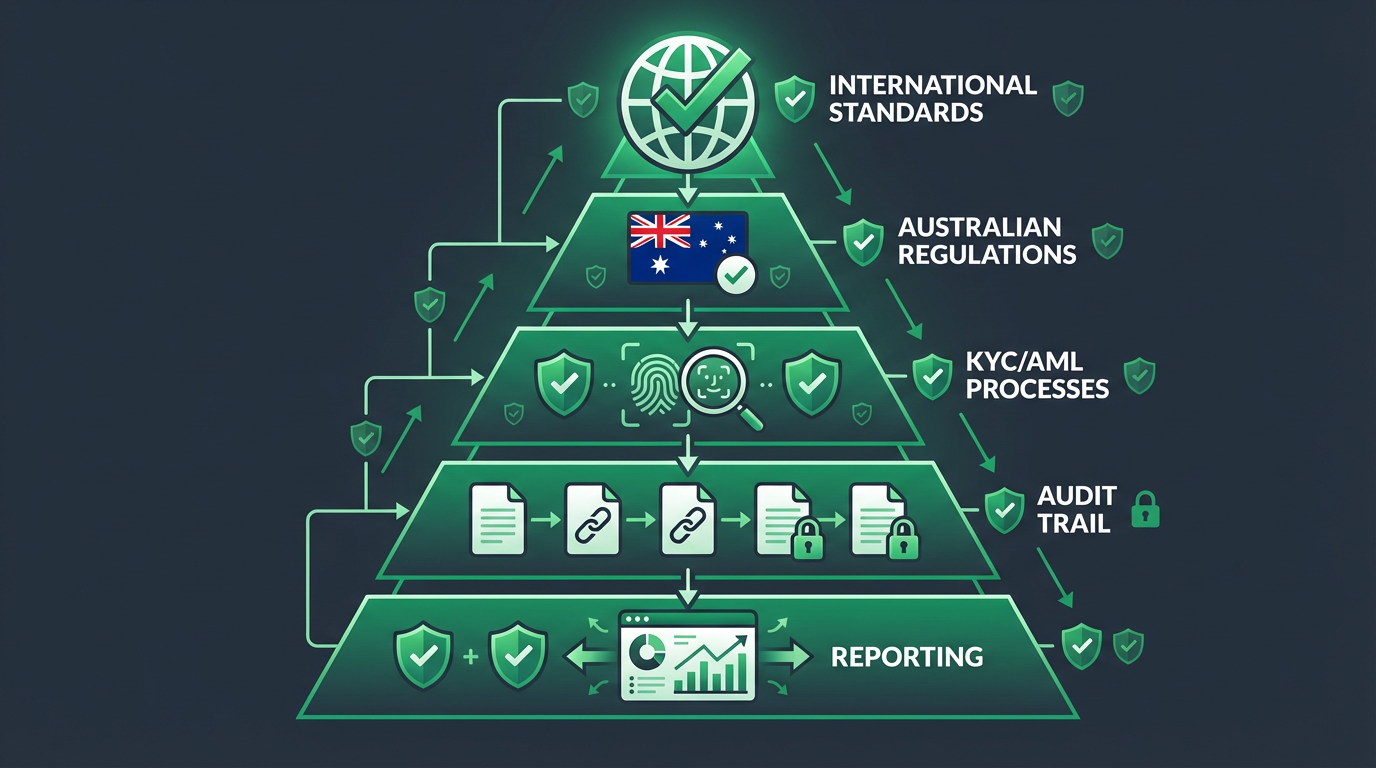
Navigating Australia's regulatory framework for digital assets and tokenized securities requires deep expertise across multiple regulatory domains. This comprehensive guide examines ASIC requirements, AUSTRAC obligations, Privacy Act compliance, and emerging regulations shaping the tokenization landscape.
ASIC Regulatory Framework for Digital Assets
The Australian Securities and Investments Commission (ASIC) applies existing financial services laws to digital assets, focusing on substance over form. Understanding how traditional regulations apply to tokenized assets is critical for compliant operations.
Managed Investment Scheme Classification
Most tokenized assets fall under the Corporations Act 2001 definition of a "managed investment scheme" (MIS). The three-part test determines MIS classification:
- People contribute money or money's worth: Investors purchase tokens with fiat or cryptocurrency
- To acquire rights to benefits from the scheme: Token holders receive distributions, capital appreciation, or other returns
- Contributions are pooled or used in a common enterprise: Multiple investors' funds combine to acquire or manage the underlying asset
- Investors do not have day-to-day control: Professional management team handles asset operations
If all four elements are present, the arrangement is likely a managed investment scheme requiring registration and compliance with MIS regulations.
Registration Requirements
Operating a registered MIS requires:
- Responsible Entity (RE): Public company holding an AFSL authorizing MIS operation
- Compliance Plan: Document detailing how the RE ensures scheme compliance
- Constitution: Legal framework governing the scheme's operation
- Compliance Committee: Oversight body for schemes exceeding $500M or with >500 members
ASIC Registration Process
The registration process typically takes 3-6 months and involves:
| Stage | Duration | Key Activities |
|---|---|---|
| Pre-Application | 4-8 weeks | Establish RE company, obtain AFSL, draft constitution and compliance plan |
| Application Lodgement | 1 week | Submit Form 5106, constitution, compliance plan, and supporting documents |
| ASIC Review | 6-12 weeks | ASIC reviews application, requests additional information |
| Registration | 1 week | ASIC issues registration, scheme can commence operations |
Product Disclosure Statement (PDS) Requirements
Before offering tokens to investors, issuers must prepare and lodge a Product Disclosure Statement with ASIC. The PDS serves as the primary disclosure document for potential investors.
Essential PDS Content
A compliant PDS must include:
- Significant Features: Detailed description of the tokenized asset and investment structure
- Significant Benefits: Expected returns, distribution mechanisms, and potential capital appreciation
- Significant Risks: Comprehensive risk disclosure covering asset-specific, technology, and market risks
- Fees & Costs: Management fees, performance fees, transaction costs, and indirect cost ratios
- How to Invest: Clear instructions for acquiring tokens and managing investments
- How to Withdraw: Redemption processes and any restrictions on withdrawals
- Additional Information: Tax implications, corporate governance, and complaints handling
PDS for Tokenized Assets: Unique Considerations
Tokenized asset PDS documents must address blockchain-specific risks:
- Smart Contract Risk: Potential bugs or exploits in token contracts
- Blockchain Network Risk: Network congestion, forks, or attacks
- Key Management Risk: Loss of private keys or unauthorized access
- Regulatory Uncertainty: Evolving blockchain regulations
- Technology Obsolescence: Rapid changes in blockchain technology
Our platform includes automated PDS generation tools that ensure all required disclosures are present while adapting to specific asset characteristics and blockchain implementations.
Australian Financial Services License (AFSL) Requirements
Operating a tokenization platform typically requires an AFSL authorizing specific services.
Relevant AFSL Authorizations
- Deal in Securities: Issuing and arranging tokenized securities
- Provide Custody Services: Holding client tokens and assets
- Operate Managed Investment Scheme: Acting as responsible entity
- Provide Financial Product Advice: If offering investment recommendations
AFSL Obligations
AFSL holders must maintain:
- Adequate Resources: Financial, technological, and human resources to operate sustainably
- Competence: Appropriately qualified staff and robust training programs
- Compliance Systems: Policies, procedures, and monitoring to ensure regulatory adherence
- Risk Management: Identification and mitigation of operational, financial, and compliance risks
- Dispute Resolution: Membership in AFCA and internal complaints handling processes
Qoney's platform includes comprehensive compliance management tools that help AFSL holders meet these obligations efficiently.
AUSTRAC Anti-Money Laundering Framework
The Anti-Money Laundering and Counter-Terrorism Financing Act 2006 (AML/CTF Act) applies to digital currency exchange services, including tokenization platforms.
Reporting Entity Registration
Tokenization platforms must register with AUSTRAC as reporting entities. Registration triggers ongoing AML/CTF obligations including:
- AML/CTF Program development and maintenance
- Customer identification and verification
- Ongoing customer due diligence
- Transaction monitoring and reporting
- Record keeping requirements
Customer Due Diligence (CDD) Requirements
AUSTRAC mandates risk-based CDD procedures for all customers.
Standard CDD Process
- Customer Identification: Collect full name, date of birth, residential address
- Verification: Verify identity using reliable and independent documentation
- Beneficial Ownership: For entities, identify individuals with >25% ownership or control
- Purpose & Nature: Understand the customer's intended use of services
- Risk Assessment: Classify customer risk level based on ML/TF exposure
Enhanced Due Diligence (EDD)
High-risk customers require enhanced due diligence:
- Politically Exposed Persons (PEPs): Senior government officials and their associates
- High-Risk Jurisdictions: Countries with weak AML/CTF frameworks or sanctions
- Complex Corporate Structures: Entities with opaque ownership or unusual structures
- Unusual Transaction Patterns: Activity inconsistent with customer profile
EDD measures include:
- Senior management approval for onboarding
- Additional information on source of funds and wealth
- Enhanced ongoing monitoring of transactions
- More frequent customer reviews
Transaction Monitoring & Reporting
Reporting entities must monitor transactions for suspicious activity and submit various reports to AUSTRAC.
Suspicious Matter Reports (SMRs)
SMRs must be filed when:
- Reasonable grounds to suspect transaction involves proceeds of crime
- Reasonable grounds to suspect transaction is terrorism financing
- Transaction occurs in circumstances that give rise to suspicion
Common red flags in tokenization platforms:
- Large or unusual cash transactions
- Rapid movement of funds with no apparent business purpose
- Transactions involving high-risk jurisdictions
- Customer reluctance to provide information or documentation
- Structuring transactions to avoid reporting thresholds
Threshold Transaction Reports (TTRs)
Physical currency transactions exceeding $10,000 AUD require TTR filing within 10 business days. This applies when fiat currency is exchanged for tokens or vice versa.
International Funds Transfer Instructions (IFTIs)
Cross-border transactions require IFTI reporting within 10 business days. For tokenization platforms, this includes:
- Fiat currency transfers to/from foreign accounts
- Cross-border token transfers representing value
Automated AML/CTF Compliance
Qoney's platform automates AML/CTF compliance through sophisticated monitoring systems:
AI-Powered Transaction Monitoring
Machine learning algorithms analyze transaction patterns in real-time, identifying anomalies that may indicate suspicious activity. The system learns from historical data, continuously improving detection accuracy while reducing false positives.
Key monitoring rules include:
- Large transaction alerts (configurable thresholds)
- Velocity checks (multiple transactions in short timeframes)
- Geographic risk scoring (high-risk jurisdiction flags)
- Peer group analysis (deviation from similar customer behaviors)
- Structuring detection (patterns designed to avoid reporting thresholds)
Automated Identity Verification
Our KYC engine integrates with government databases and third-party verification services:
- Document Verification: OCR and forensic analysis of government-issued IDs
- Liveness Detection: Biometric verification to prevent deepfakes and photos of photos
- Database Checks: Matching against government registries and watchlists
- PEP & Sanctions Screening: Real-time checking against global databases
Verification typically completes in under 5 minutes for standard customers, dramatically improving onboarding experience while maintaining compliance rigor.
Privacy Act Compliance for Tokenization Platforms
The Privacy Act 1988 governs collection, use, and disclosure of personal information. Tokenization platforms handle sensitive financial and identity data, making privacy compliance critical.
Australian Privacy Principles (APPs)
The 13 APPs establish comprehensive privacy obligations:
APP 1: Open and Transparent Management of Personal Information
Platforms must maintain a clear privacy policy explaining:
- What personal information is collected
- How it's collected, held, used, and disclosed
- How individuals can access and correct their information
- How complaints are handled
APP 3: Collection of Solicited Personal Information
Only collect personal information that is reasonably necessary for platform functions. For tokenization, this includes:
- Identity Information: For KYC/AML compliance
- Financial Information: For transaction processing and reporting
- Contact Information: For service delivery and notifications
APP 5: Notification of Collection
At or before collection, notify individuals about:
- Identity and contact details of the collecting entity
- Purposes of collection
- Consequences if information is not provided
- Third parties to whom information may be disclosed
- Whether overseas disclosure is likely
APP 6: Use or Disclosure of Personal Information
Use and disclose personal information only for the primary purpose of collection or related secondary purposes. Key exceptions include:
- Individual consent
- Legal requirements (e.g., AUSTRAC reporting)
- Enforcement of law
- Public health and safety
APP 8: Cross-Border Disclosure
When disclosing personal information overseas (e.g., to foreign blockchain nodes or cloud providers):
- Take reasonable steps to ensure overseas recipients comply with APPs
- Obtain individual consent
- Ensure disclosure is required or authorized by law
For blockchain-based systems, this creates unique challenges as transaction data is replicated across global node networks. Our platform addresses this through:
- Minimizing personal information stored on-chain
- Encrypting sensitive data before blockchain storage
- Maintaining off-chain linkage to on-chain identifiers
APP 11: Security of Personal Information
Take reasonable steps to protect personal information from misuse, interference, loss, unauthorized access, modification, or disclosure.
Our platform implements:
- Encryption at Rest: AES-256 encryption for all databases
- Encryption in Transit: TLS 1.3 for all network communications
- Access Controls: Role-based access with multi-factor authentication
- Audit Logging: Comprehensive logging of all data access
- Secure Destruction: Cryptographic wiping of decommissioned storage
APP 12: Access to Personal Information
Individuals have the right to request access to their personal information. Platforms must provide access within 30 days unless an exception applies.
APP 13: Correction of Personal Information
Take reasonable steps to ensure personal information is accurate, up-to-date, complete, relevant, and not misleading. Individuals can request corrections, which must be processed within 30 days.
Privacy by Design in Blockchain Systems
Tokenization platforms face unique privacy challenges due to blockchain's immutable nature. Once data is on-chain, it cannot be edited or deleted—creating tension with APP 12 and 13 correction rights.
Architectural Solutions
Our platform resolves this through careful architecture:
- Minimal On-Chain Data: Store only essential transaction data on blockchain
- Hash-Based References: Link on-chain transactions to off-chain records via hashes
- Mutable Off-Chain Storage: Maintain personal information in traditional databases
- Zero-Knowledge Proofs: Prove facts without revealing underlying data
This architecture preserves blockchain's integrity benefits while enabling privacy rights compliance.
Notifiable Data Breach Scheme
Since February 2018, the Privacy Act includes mandatory data breach notification requirements.
When to Notify
Notification is required when:
- Unauthorized access to or disclosure of personal information occurs
- Personal information is lost in circumstances where unauthorized access or disclosure is likely
- The breach is likely to result in serious harm to affected individuals
Notification Process
When a notifiable breach occurs:
- Assessment (30 days): Investigate whether breach meets notification criteria
- Affected Individual Notification: Directly notify impacted individuals
- OAIC Notification: Submit statement to Office of the Australian Information Commissioner
- Public Statement: If individuals cannot be identified, publish public notification
Breach Prevention & Response
Our platform implements comprehensive breach prevention:
- Intrusion Detection: Real-time monitoring for unauthorized access attempts
- Penetration Testing: Quarterly security assessments by independent auditors
- Incident Response Plan: Documented procedures for breach identification, containment, and remediation
- Employee Training: Regular security awareness training for all staff
- Vendor Management: Contractual security requirements for third-party service providers
Emerging Regulatory Developments
Treasury Consultation on Digital Asset Regulation
The Australian Treasury is developing a comprehensive regulatory framework for digital assets, with proposed reforms including:
- Custody and Licensing: Specific licensing regime for digital asset custodians
- Market Integrity: Rules governing digital asset trading venues
- Consumer Protection: Enhanced disclosure and conduct obligations
- Stablecoin Regulation: Prudential requirements for stablecoin issuers
CBDC Pilot Programs
The Reserve Bank of Australia (RBA) is exploring central bank digital currency (CBDC) through pilot projects. A retail CBDC could dramatically change the tokenization landscape by providing government-issued digital currency for settlement.
Cross-Border Coordination
Australia participates in international working groups developing global digital asset standards:
- Financial Stability Board (FSB): Coordinating regulatory approaches across G20 nations
- IOSCO: Developing securities regulator guidelines for digital assets
- FATF: Anti-money laundering standards for virtual assets
Compliance Technology & Automation
RegTech Integration
Modern compliance requires sophisticated RegTech solutions:
Automated Policy Engines
Our platform translates regulatory requirements into executable code:
- ASIC MIS requirements → Smart contract conditions
- AUSTRAC transaction limits → Automated transaction monitoring
- Privacy Act data minimization → System architecture constraints
Regulatory Change Management
Regulations evolve continuously. Our platform tracks regulatory changes through:
- Natural language processing of regulatory releases
- Impact analysis on existing policies
- Automated policy updates when regulations change
- Audit trail of all compliance rule modifications
Compliance Reporting Automation
Generate regulatory reports automatically:
- ASIC Reporting: Breach notifications, compliance certificates, annual returns
- AUSTRAC Reporting: SMRs, TTRs, IFTIs generated from transaction data
- ATO Reporting: Tax reporting for distributions and capital events
- AFCA Reporting: Complaints data and resolution statistics
Conclusion: Building Compliant Tokenization Infrastructure
Regulatory compliance is not a checkbox exercise but an ongoing commitment requiring sophisticated systems, expert knowledge, and continuous monitoring.
Successful tokenization platforms integrate compliance into their core architecture rather than bolting it on as an afterthought. From smart contract design through operational procedures, every aspect must consider regulatory requirements.
Key principles for compliant tokenization:
- Substance Over Form: Focus on economic reality, not technical implementation
- Privacy by Design: Build privacy protections into architecture from the beginning
- Automation with Oversight: Leverage technology for efficiency while maintaining human judgment
- Continuous Monitoring: Track regulatory developments and adapt promptly
- Transparent Communication: Keep regulators, investors, and stakeholders informed
As the regulatory landscape matures, compliant platforms gain competitive advantages through reduced regulatory risk, investor confidence, and operational efficiency.
For platforms like Qoney, deep compliance integration isn't just about avoiding penalties—it's about building the trusted infrastructure that enables institutional adoption of tokenized asset markets.
The future belongs to platforms that view compliance not as a burden but as a source of competitive differentiation and sustainable growth.
Graham Chee
FCPA, GRCP, GRCA, IAIP, IRMP, ICEP, IAAP - Principal Advisor & Founder
Graham Chee is a highly qualified business advisor with over 25 years of professional experience spanning accounting, taxation, investment management, governance, risk, and compliance. As a Fellow of CPA Australia (FCPA), Graham brings deep technical expertise combined with practical business acumen. His qualifications include Governance Risk and Compliance Professional (GRCP), Governance Risk and Compliance Auditor (GRCA), Integrated Artificial Intelligence Professional (IAIP), Integrated Risk Management Professional (IRMP), Integrated Compliance and Ethics Professional (ICEP), and Integrated Audit and Assurance Professional (IAAP). Graham has advised hundreds of Australian SMEs on strategic planning, succession, business valuation, and compliance matters, helping business owners build sustainable, valuable enterprises.