AI-Powered Tokenization: How 13 Specialized Agents Transform RWA Operations
Discover how artificial intelligence is revolutionizing Real-World Asset tokenization through multi-agent architectures, hierarchical learning systems, and autonomous coordination—featuring detailed analysis of Qoney's 13 specialized AI agents and their collaboration patterns.
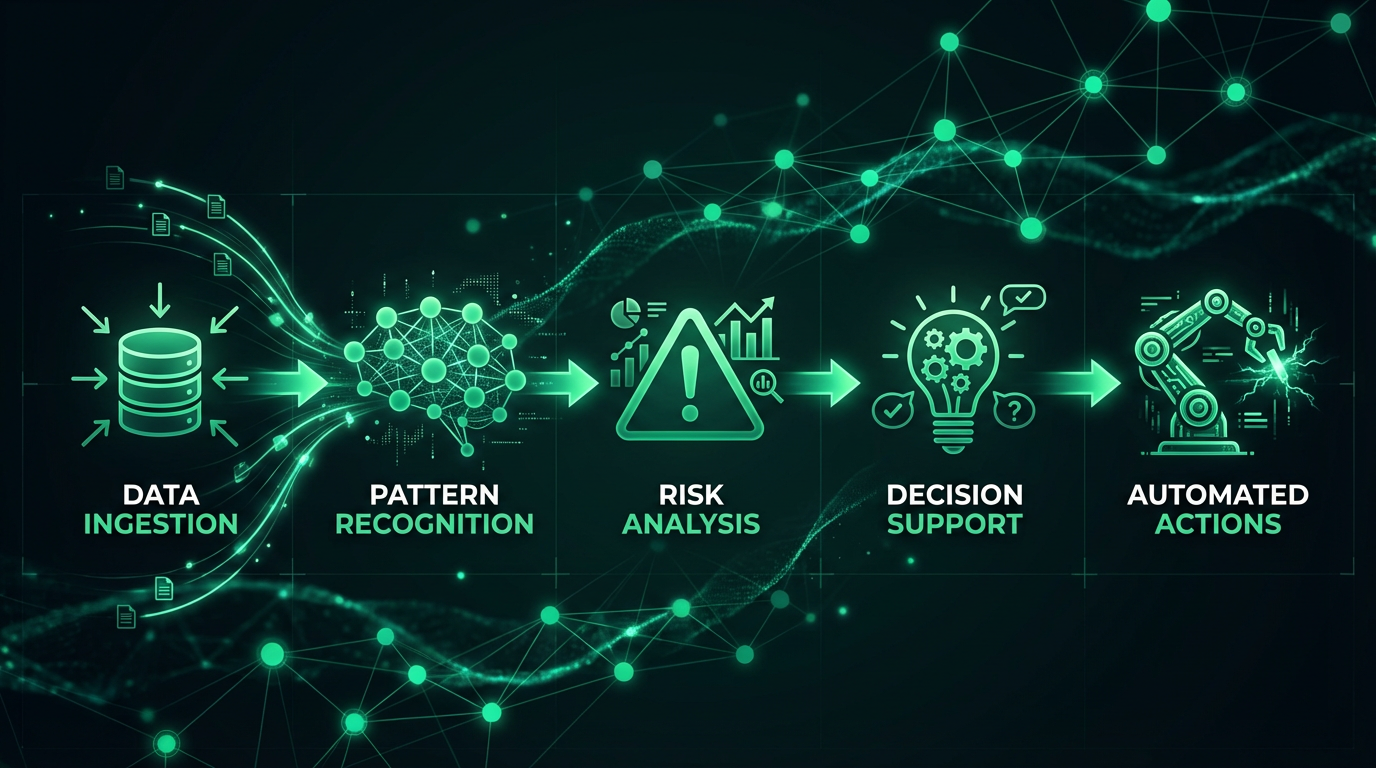
Artificial intelligence is transforming every aspect of Real-World Asset (RWA) tokenization—from initial due diligence through ongoing asset management. This comprehensive exploration examines how Qoney's 13 specialized AI agents work together to create an institutional-grade intelligent tokenization platform.
The Multi-Agent Architecture
Traditional software systems follow deterministic rules: if X happens, do Y. Modern AI systems learn patterns from data, enabling sophisticated decision-making in ambiguous situations. Qoney combines both approaches through a multi-agent architecture where specialized AI agents collaborate to handle complex workflows.
Why Multiple Agents Instead of One?
A single general-purpose AI agent would struggle with the depth of expertise required across tokenization domains. Consider the challenge of evaluating a commercial property for tokenization:
- Legal Domain: Reviewing title deeds, easements, zoning restrictions
- Financial Domain: Analyzing cash flows, cap rates, financing structures
- Compliance Domain: Ensuring ASIC/AUSTRAC requirements are met
- Technical Domain: Implementing smart contracts with correct business logic
Each domain requires specialized knowledge. Multi-agent systems enable deep expertise in each area while coordinating across domains for holistic analysis.
The 13 Specialized Agents
Qoney deploys thirteen specialized agents, each focused on specific aspects of tokenization operations:
1. Isabella: Chief Risk Officer
Primary Function: Comprehensive risk assessment and management
Key Capabilities:
- Counterparty risk analysis using credit models and market data
- Market risk evaluation including liquidity and volatility assessment
- Regulatory risk scoring based on jurisdiction and asset type
- Operational risk identification in workflows and systems
AI Techniques: Ensemble models combining gradient boosting for structured risk factors with neural networks for unstructured data (news, sentiment analysis)
2. Liam: Chief Investment Officer
Primary Function: Investment analysis and return projections
Key Capabilities:
- Financial modeling and DCF analysis
- Market comparables identification and benchmarking
- Scenario analysis (base case, bull case, bear case)
- Portfolio optimization and allocation recommendations
AI Techniques: Time series forecasting using LSTM networks for cash flow projection, reinforcement learning for portfolio optimization
3-7. The Accounting Suite (Five Agents)
Five specialized agents handle different accounting functions:
General Ledger Agent:
- Chart of accounts management
- Journal entry generation and posting
- Period close automation
- Financial statement preparation
Accounts Receivable Agent:
- Invoice generation for token sales and distributions
- Payment tracking and reconciliation
- Collections management
- Aging analysis
Accounts Payable Agent:
- Vendor invoice processing
- Payment scheduling and execution
- Three-way matching (PO, receipt, invoice)
- Spend analytics
Payroll Agent:
- Employee compensation calculations
- Tax withholding and reporting
- Superannuation management
- Payroll compliance
Tax Agent:
- Tax provision calculations
- GST reporting
- Transfer pricing analysis for multi-jurisdictional structures
- Tax optimization strategies
AI Techniques: Rule-based systems for deterministic accounting rules combined with OCR and NLP for document processing, anomaly detection for fraud prevention
8. Compliance Agent
Primary Function: Regulatory compliance monitoring and enforcement
Key Capabilities:
- ASIC managed investment scheme requirement verification
- AUSTRAC AML/CTF transaction monitoring
- Privacy Act data handling audit
- Automated regulatory reporting
AI Techniques: Natural language processing for regulatory text analysis, graph neural networks for entity relationship mapping (beneficial ownership), supervised learning for suspicious transaction classification
9. Legal Agent
Primary Function: Legal document analysis and contract management
Key Capabilities:
- Due diligence document review
- Contract clause extraction and risk flagging
- Legal precedent research
- Regulatory update tracking
AI Techniques: Large language models fine-tuned on legal documents, named entity recognition for key clause identification, semantic search for precedent retrieval
10. Operations Agent
Primary Function: Operational workflow optimization
Key Capabilities:
- Process efficiency analysis
- Resource allocation optimization
- Performance metric tracking
- Incident management and resolution
AI Techniques: Process mining for workflow analysis, reinforcement learning for resource optimization, anomaly detection for incident identification
11. Technology Agent
Primary Function: Technical infrastructure management
Key Capabilities:
- Smart contract auditing and deployment
- Blockchain network monitoring
- Security vulnerability assessment
- Performance optimization
AI Techniques: Static analysis for smart contract bugs, time series analysis for performance monitoring, adversarial testing for security assessment
12. Investor Relations Agent
Primary Function: Investor communication and engagement
Key Capabilities:
- Investor query handling via chatbot interface
- Personalized reporting and insights
- Sentiment analysis of investor feedback
- Engagement scoring and outreach prioritization
AI Techniques: Natural language understanding for query interpretation, generative AI for response drafting, sentiment analysis for feedback classification
13. Market Intelligence Agent
Primary Function: Market data aggregation and analysis
Key Capabilities:
- Real-time market data ingestion from multiple sources
- Trend identification and forecasting
- Competitive landscape analysis
- Investment opportunity discovery
AI Techniques: Web scraping and NLP for unstructured data, time series forecasting for market trends, clustering for opportunity identification
Agent Coordination & Collaboration
Individual agents provide specialized capabilities, but real power emerges when agents collaborate. Qoney implements three high-value collaboration patterns:
Pattern 1: Deal Intelligence Pipeline
Participants: Compliance Agent → Legal Agent → Liam (Investment)
Use Case: Evaluating new tokenization opportunities
Workflow:
- Compliance Screening (Agent 8): Initial regulatory feasibility check
- Jurisdiction analysis
- Asset type compliance requirements
- Licensing requirements
- Go/No-Go decision in <2 minutes
- Legal Due Diligence (Agent 9): Document review for compliant deals
- Title verification
- Contract analysis
- Encumbrance identification
- Risk flag summary
- Investment Analysis (Agent 2): Financial modeling for legally clean deals
- Cash flow projections
- Valuation analysis
- Return scenarios
- Investment recommendation
Outcome: Sequential filtering ensures resources are only invested in deals that pass regulatory, legal, and financial thresholds. Reduces time-to-decision from weeks to hours.
Pattern 2: Budget Optimization Workflow
Participants: GL Agent → AP Agent → Operations Agent
Use Case: Identifying and implementing cost savings
Workflow:
- Spend Analysis (Agent 3): GL Agent identifies cost anomalies
- Category spending trends
- Vendor cost increases
- Budget variance analysis
- Vendor Evaluation (Agent 5): AP Agent analyzes vendor relationships
- Payment terms optimization
- Volume discount opportunities
- Alternative vendor options
- Process Improvement (Agent 10): Operations Agent implements changes
- Workflow optimization
- Automation opportunities
- Resource reallocation
Outcome: Continuous cost optimization without manual analysis. Typical savings: 8-15% of operating expenses.
Pattern 3: Transaction Validation Chain
Participants: GL Agent → Liam (Investment) → Compliance Agent
Use Case: Real-time transaction validation
Workflow:
- Accounting Validation (Agent 3): Verify transaction correctness
- Balance sufficiency
- Account mapping correctness
- Mathematical accuracy
- Investment Policy Check (Agent 2): Ensure transaction aligns with investment mandate
- Concentration limits
- Asset allocation targets
- Risk budget compliance
- Regulatory Compliance (Agent 8): Confirm regulatory adherence
- Transfer restriction compliance
- Investor accreditation verification
- Reporting obligations
Outcome: Real-time transaction approval/rejection in <1 second with comprehensive validation across multiple domains.
Hierarchical Learning System
Qoney's agents don't just execute predefined rules—they learn from every interaction, continuously improving their performance.
Six-Level Knowledge Growth Model
Our hierarchical learning engine implements a six-stage knowledge evolution framework:
Level 1: SEED - Initial Data Points
Raw data from transactions, documents, and interactions:
- Transaction records
- User actions
- External market data
- Sensor readings
Level 2: ROOT - Pattern Identification
Basic patterns emerge from seed data:
- "Transactions from jurisdiction X have 30% higher failure rates"
- "Documents containing phrase Y typically indicate Z"
- "Asset type A shows seasonal price variation"
Level 3: TREE - Domain Knowledge
Patterns combine into domain-specific knowledge:
- "Commercial properties with long-term leases to investment-grade tenants are lower risk"
- "Jurisdictions with unclear digital asset regulations require enhanced due diligence"
- "Market liquidity decreases 40% during December holiday period"
Level 4: BRANCH - Cross-Domain Insights
Knowledge from multiple domains combines:
- "Deals requiring complex legal structuring (Legal) typically have lower ROI (Investment) but better regulatory positioning (Compliance)"
- "Higher operational costs (Accounting) correlate with improved investor satisfaction (IR) through enhanced reporting"
Level 5: LEAF - Predictive Models
Comprehensive understanding enables prediction:
- Predicting deal close probability given characteristics
- Forecasting investor redemption likelihood
- Anticipating regulatory inquiry based on transaction patterns
Level 6: FOREST - Ecosystem Intelligence
Platform-wide patterns emerge:
- Market cycles and their impact on platform operations
- Regulatory trends affecting multiple jurisdictions
- Technology adoption curves across user segments
Continuous Learning Pipeline
Learning occurs continuously through several mechanisms:
1. Supervised Learning from Outcomes
Every agent action produces an outcome. Did the compliance check prevent a regulatory breach? Did the investment analysis accurately predict returns? These outcomes provide labeled training data for model improvement.
2. Reinforcement Learning from Feedback
Users provide explicit and implicit feedback on agent performance:
- Explicit: Thumbs up/down on responses, correction of agent outputs
- Implicit: Whether users act on agent recommendations, time spent reviewing agent analysis
Agents optimize for positive feedback while learning which actions produce superior outcomes.
3. Transfer Learning Across Agents
Insights from one agent transfer to others. If the Legal Agent identifies that certain contract clauses increase dispute risk, this insight informs:
- Compliance Agent: Add clause review to regulatory checks
- Risk Agent (Isabella): Adjust risk scoring for deals with those clauses
- Operations Agent: Flag deals requiring enhanced contract review
4. Autonomous Ingestion from External Sources
The Market Intelligence Agent continuously harvests data from external sources:
- Regulatory agency websites for new guidance
- Financial news for market trends
- Academic publications for methodology improvements
- Competitor platforms for feature benchmarking
This autonomous ingestion ensures agents remain current with external developments without manual updates.
Technical Implementation Details
Agent Communication Protocol
Agents communicate via standardized message protocol:
Task Messages:
type: Task category (due_diligence, compliance_check, etc.)priority: URGENT, HIGH, NORMAL, LOWpayload: Task-specific datarequester: Originating agent or userdeadline: Expected completion time
Insight Messages:
category: PATTERN, RECOMMENDATION, WARNING, etc.confidence: 0-1 score indicating certaintycontent: Insight descriptionevidence: Supporting dataexpiry: Time until insight becomes stale
Task Queue Architecture
The coordination system manages agent workload through priority queues:
- Task Reception: Incoming tasks enter priority queue
- Agent Selection: Coordinator assigns task to appropriate agent based on:
- Agent specialization
- Current workload
- Task priority
- SLA requirements
- Execution: Agent processes task, potentially spawning sub-tasks for other agents
- Result Recording: Outcomes stored in knowledge base for learning
- Insight Sharing: Valuable insights broadcast to potentially interested agents
Model Architecture
Different agents employ different model architectures optimized for their tasks:
Structured Data Agents (Accounting Suite, Operations)
- Primary Models: Gradient boosting (XGBoost, LightGBM) for classification and regression
- Strengths: Excellent performance on tabular data, interpretable feature importance
- Use Cases: Transaction classification, anomaly detection, spend forecasting
Unstructured Data Agents (Legal, Compliance, IR)
- Primary Models: Transformer-based language models (BERT variants, GPT)
- Strengths: Deep understanding of textual data, context-aware processing
- Use Cases: Document analysis, query answering, regulatory text interpretation
Time Series Agents (Investment, Market Intelligence)
- Primary Models: LSTM networks, Temporal Convolutional Networks
- Strengths: Capture temporal dependencies, handle irregular sampling
- Use Cases: Cash flow forecasting, market trend prediction, seasonality detection
Graph-Based Agents (Risk, Compliance)
- Primary Models: Graph Neural Networks (GCN, GraphSAGE)
- Strengths: Analyze entity relationships, propagate information through networks
- Use Cases: Beneficial ownership mapping, contagion risk assessment, fraud detection
Performance Metrics & Monitoring
Agent performance is continuously monitored across multiple dimensions:
| Metric Category | Specific Metrics | Target |
|---|---|---|
| Accuracy | Precision, Recall, F1 Score | Varies by agent (typically >95%) |
| Latency | Response time, Task completion time | <3 seconds for simple tasks |
| Throughput | Tasks completed per hour | Depends on task complexity |
| Reliability | Success rate, Error rate | >99.5% success rate |
| Learning Rate | Performance improvement over time | Positive trajectory |
Metrics feed into automated alerting systems that notify engineers when performance degrades below thresholds.
Real-World Impact: Case Studies
Case Study 1: Commercial Property Tokenization
Asset: $45M office building in Sydney CBD
Challenge: Complete due diligence and prepare for tokenization in 2 weeks
Agent Collaboration:
- Day 1-2: Legal Agent reviews 500+ pages of documentation
- Identified 3 minor title encumbrances requiring resolution
- Flagged favorable lease terms with investment-grade tenants
- Day 3-5: Investment Agent (Liam) conducts financial analysis
- Built 10-year cash flow model
- Identified 12% IRR with conservative assumptions
- Recommended 70% LTV tokenization structure
- Day 6-7: Compliance Agent verifies regulatory requirements
- Confirmed ASIC MIS registration pathway
- Prepared PDS template with risk disclosures
- Established KYC requirements for investors
- Day 8-10: Technology Agent deploys smart contracts
- Created 10,000,000 tokens on XRPL
- Implemented transfer restrictions
- Set up automated distribution logic
- Day 11-14: Operations Agent coordinates launch
- Investor onboarding workflow setup
- Payment processing integration
- Reporting dashboard configuration
Outcome: Deal launched on schedule with 97% of $31.5M target raised within 48 hours. Traditional process would have taken 8-12 weeks.
Case Study 2: Suspicious Transaction Detection
Scenario: New investor onboards and immediately initiates large transaction
Challenge: Determine if transaction is legitimate or requires SAR filing
Agent Collaboration:
- Transaction Monitor: Compliance Agent flags unusual transaction pattern
- New account (<7 days old)
- Transaction 10x larger than account average
- Jurisdiction flagged as higher risk
- Enhanced Due Diligence: Agent initiates EDD workflow
- Source of funds verification request sent
- Beneficial ownership research conducted
- Sanctions and PEP screening re-run
- Risk Assessment: Isabella (Risk Agent) analyzes findings
- Identified legitimate business purpose
- Verified source of funds documentation
- Confirmed no sanctions matches
- Risk score: Medium (below SAR threshold)
- Decision: Transaction approved with enhanced monitoring
- Transaction processed successfully
- Account flagged for ongoing monitoring
- No SAR filing required
Outcome: Completed analysis in 15 minutes vs. 4-6 hours manually. Legitimate transaction approved quickly while maintaining regulatory compliance.
The Future of AI in Tokenization
Emerging Capabilities
1. Autonomous Deal Sourcing
Future agents will proactively identify tokenization opportunities:
- Scanning property listings for attractive assets
- Monitoring distressed debt markets for acquisition opportunities
- Analyzing commodity markets for tokenization demand
2. Predictive Compliance
Instead of reacting to regulatory changes, agents will anticipate them:
- Analyzing regulatory consultation papers to predict rule changes
- Monitoring enforcement actions to understand regulatory priorities
- Adapting policies proactively before regulations take effect
3. Investor Behavior Prediction
Deep learning on investor patterns will enable:
- Redemption forecasting for liquidity management
- Personalized product recommendations
- Churn prediction and retention strategies
4. Market Making Agents
Specialized agents will provide liquidity in tokenized asset markets:
- Dynamic bid/ask spread calculation
- Inventory risk management
- Cross-asset arbitrage execution
Ethical AI & Governance
As AI agents gain autonomy, governance becomes critical:
Explainability
All agent decisions must be explainable:
- Feature importance for predictions
- Reasoning chains for complex decisions
- Confidence intervals for uncertainty quantification
Human Oversight
High-stakes decisions require human approval:
- SAR filing decisions escalate to compliance officers
- Investment recommendations require investment committee approval
- Major operational changes need management sign-off
Bias Monitoring
Continuous testing for algorithmic bias:
- Demographic parity in investor treatment
- Equal opportunity across protected classes
- Disparate impact analysis for automated decisions
Conclusion: The Intelligent Tokenization Platform
Artificial intelligence transforms tokenization from a manual, time-consuming process into an efficient, scalable operation. By deploying specialized agents that collaborate intelligently, Qoney achieves:
- 10x Speed: Weeks become days for complex workflows
- 95%+ Accuracy: Superhuman performance on specialized tasks
- 24/7 Operation: Continuous monitoring and processing
- Continuous Learning: Performance improves with every interaction
- Scalability: Handle 100x volume without proportional cost increase
The multi-agent architecture isn't just a technical choice—it's a fundamental reimagining of how financial services operate in the digital age.
As AI capabilities advance, tokenization platforms that successfully integrate intelligence across their operations will dominate. Manual processes cannot compete with the speed, accuracy, and scalability of well-designed AI systems.
For institutional adopters, the question isn't whether to embrace AI in tokenization—it's how quickly you can implement intelligent systems before competitors gain insurmountable advantages.
The future of asset management is intelligent, automated, and tokenized. Welcome to that future.
Graham Chee
FCPA, GRCP, GRCA, IAIP, IRMP, ICEP, IAAP - Principal Advisor & Founder
Graham Chee is a highly qualified business advisor with over 25 years of professional experience spanning accounting, taxation, investment management, governance, risk, and compliance. As a Fellow of CPA Australia (FCPA), Graham brings deep technical expertise combined with practical business acumen. His qualifications include Governance Risk and Compliance Professional (GRCP), Governance Risk and Compliance Auditor (GRCA), Integrated Artificial Intelligence Professional (IAIP), Integrated Risk Management Professional (IRMP), Integrated Compliance and Ethics Professional (ICEP), and Integrated Audit and Assurance Professional (IAAP). Graham has advised hundreds of Australian SMEs on strategic planning, succession, business valuation, and compliance matters, helping business owners build sustainable, valuable enterprises.